We developed a mathematical method of scoring queer shows that generates a numeric score from 0 to 100 for all TV shows in the LezWatch.TV database. This is intended to help people identify shows that are ‘better’ for queer audiences than others.
A Brief History
In June of 2017, Mika developed the first ‘formula’ that would later become show scoring while waiting in line for a taping of One Day at a Time. The system was soft-released in August, and by October 2017 the first iteration of the scoring system was made public. The formulas were tweaked and adjusted, in order to give more weight to important aspects of shows (and less to others), until March 2018, when the second major release was made. Since then, the calculations have been tweaked here and there to continue to reward positive representation on television in an automated, and balanced, manner.
After all the work adding in shows, seasons, and characters-by-year, the system got a heavy character based overhaul in August 2026. We now know which years each character was actually on screen, and the score finally uses it.
Scoring System Last Updated: 25 August 2026
Example
Every show page has a section in the sidebar for “Is It Worth Watching?” In that section is a mention of each show’s score:
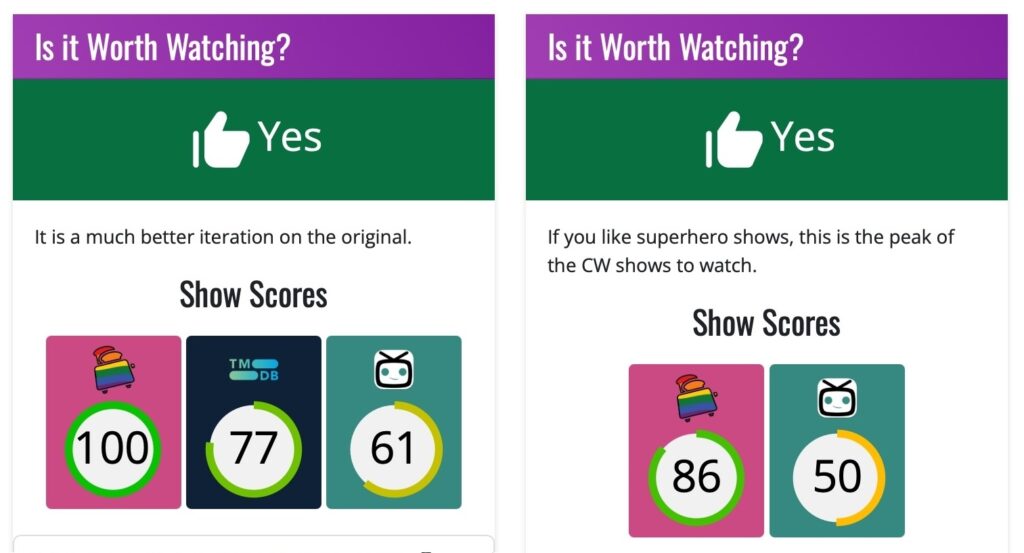
This score enumerates the contextual value of a show. The higher the score value, the better the show is for a queer audience. In order to give you an idea of the show outside our queer bubble, we also provide the TMDB score and the TVMaze scores, when available.
How Scores Are Generated
Any time a show is updated (either by itself or by adding new characters to a show), the score is regenerated. The score takes into account four major aspects of any show:
- Show Ratings
- Character Survival Rate
- Character Values
- Tropes of Shows
Each of those produces its own value, and the four are averaged to give the overall show score. That average is what you see, capped at 100.
Three of the four are scored out of 100, with Show Ratings as an exception. Due to the sum of bonuses and penalties, it’s possible for a show to hit 115 max, which is why you might see a show at 100 even though it’s not ‘perfect.’
In addition, shows receive bonuses for having positive intersectional representation.
Show Ratings
When a show is added, we review it’s inherent qualities and award it points based on the following factors:
Thumb Score
All shows receive an overall ‘worth it’ factor, called the Thumb Score. This is represented by a thumb pointed up or down, or a neutral face in the case of apathy.
Scores:
- Thumbs up: +10
- Thumbs ‘meh’: +5
- Thumbs down: -10
Basic Worth (more info)
We also evaluate the worth of the show for queerness. These ratings are subjective and self-contextual. That is, the realness of a show is not impacted by the fantastical nature of the show’s setting (like Lost Girl).
Scores (0-5):
- Realness – how realistic are the queers (contextually)
- Quality – how good is the show for queer people
- Screentime – how much screen time do the queer characters get
Those scores are added together and multiplied by 3 for a max of 30.
Stars (more info)
All shows have the potential to achieve star ratings based on the queer nature of their production. A show made for queer woman, by queer women, will be a gold star. Not all shows have stars, and the majority will not.
Scores:
- Gold Star: +20
- Silver Star: +10
- Bronze Star: +5
- Anti-Star: -15 (note: no show has this yet)
Trigger Warnings
Not all shows are for all people. Trigger Warnings reflect the possible problems with shows. If a show is actively detrimental to some viewers, with abuse, or excessive violence, it’s score is downgraded.
Scores:
- Low: -5
- Medium: -10
- High: -15
Shows We Love (more info)
There are some shows that the Staff collectively decided are absolutely worth everyone’s time an attention. Those shows are rewarded appropriately.
Score:
- +40 points.
Character Survival Rate (more info)
This is a 0-100 value of characters who are alive based on percentages. If a show has 10 characters and 9 are alive, then it gets a 90. If 9 are dead, then it’s The Walking Dead and gets a 10. If they’re all dead, they get a 0.
Character Value
The more characters a show has, the more they should be rewarded, especially if the character is positive representation.
Every character earns a base value from their role. That value is then scaled by the qualities of the character, and scaled again by how long they were actually on screen. All the characters are added together, and the total is converted into a 0-100 score.
This means every character contributes something positive, however small. A character can be worth less (a lot less if you keep killing off queers) but never below nothing. We exist to document these characters, and the score should never work against us for doing it thoroughly.
Role Types
There are three basic roles a character can have: regular/main character, recurring character, and guest character. The more regular and recurring characters a show has, the better. If a show only has guest characters, then the representation tends to be negative (like Law & Order: SVU).
Scores:
- Regular Character: +5
- Recurring Character: +2
- Guest Character: +1
Since we adjust based on years a character is on a show, a recurring character can gain some points.
Casting
Representation matters, and so does queers playing queers. We don’t award a show full credit for a queer character if it cast a straight actor in the role, and a trans or non-binary character played by a cisgender actor is a different thing from one played by a trans actor.
This is judged on the first-billed actor, who is the one who played the character for most of their run (for example, Sara Lance has 4 actors, but Caity Lotz is the first-billed). Where a character was played by several actors, the lead is the one who counts. Each character is measured against one standard, not both, so these never stack:
| Character | Judged on | Cast well | Cast poorly |
|---|---|---|---|
| Trans or non-binary | Trans/non-binary casting | ×2 | ×0.5 |
| Everyone else | Queer casting | ×2 | ×1 |
A trans character played by a cisgender actor is the only case where a show is actively marked down rather than simply not rewarded. Where we don’t have an actor’s information recorded, no judgment is made.
Character Clichés and Death
- No clichés at all: ×1.25
- Dead: ×0.5
For every character is played by an out queer actor or has no clichés at all, they are awarded additional points. There are also negative points awarded for poor representation.
Because death scales a character rather than subtracting a flat amount, killing a lead costs a show far more than killing a one-scene guest (which is the actual Bury Your Gays concern). It also means a dead minor character still counts for something rather than becoming a penalty.
This new scale replaces the flat bonuses we used to award.
Time On Screen
Each character is then weighted by how many years they appeared, relative to how long the show ran. A character present for four of five seasons counts close to fully; one who turned up once counts a little.
It’s deliberately relative. A five-year regular on a five-year show isn’t penalised for the show being short, and a five-year regular on a thirty-year soap still gets real credit for those five years. We’re measuring presence, not endurance.
Working out how long a show ran turns out to be the hard part, so we use the best source available for each show, in this order:
- Our own recorded season count, for shows that have finished.
- Actual per-season air dates, which handle seasons that straddle two calendar years, two seasons landing in one year, and revivals after a long gap.
- The years between premiere and finale, less any known time off air.
- The years between premiere and finale.
Whichever we use, it can never come out lower than the number of years we have characters recorded as appearing. If our own records say people were on screen across five years, then the show didn’t run for three.
Adding It All Up
Every character’s final value is added together, and that total becomes a score out of 100 but with diminishing returns. Each additional character adds slightly less than the one before.
The gap between a show’s first well-written queer character and its second is enormous. Between its twentieth and twenty-first, much less so. There’s no cap and no cliff, so a huge cast never stops helping, it just stops helping as much. This is what stops a long-running show with hundreds of brief characters from outranking a tightly-written one.
Show Format
The stakes on representation change based on the format of a show. For long running series (like soaps, Doctor Who, and the various Law & Orders), it tends to be more difficult to get extensive representation. On the other hand, web series are generally created with the intent of providing inclusive representation. TV Movies and Mini-Series have an incredibly low bar, since they’re a completed story and rely less on ratings to encourage more representation.
Scores:
- TV Series: No change
- Web Series: Divide score by 1.25 (90 becomes 72)
- Mini Series: Divide score by 1.5 (90 becomes 60)
- TV Movie: Divide score by 2 (90 becomes 45)
Tropes of Shows
The types of tropes a show has also factors into this. There are six types of tropes:
- No Tropes: ‘No Tropes’
- Good Tropes: ‘Happy Ending’ and ‘Everyone’s Queer’
- Maybe Tropes: ‘Coming Out,’ ‘Big Queer Wedding,’ and ‘Subtext Only’
- Ploy Tropes: ‘Background Queers’, ‘Erased Queerness’, ‘Happiness then Tragedy,’ ‘Queer For Ratings,’ ‘Queer for Laughs,’ ‘Queer of the Week,’ and ‘Queerbaiting’
- Bad Tropes: ‘The Big Bad Queers,’ ‘In Prison’ and ‘Queerbashing’
- Regular Tropes: Everything else
In certain situations, a ‘Maybe’ Trope is a bad one. For example, ‘Big Queer Wedding’ when combined with ‘Queer for Ratings’ usually means the wedding was a one-off character we never saw again. On the other hand, if you combine it with ‘Everyone’s Queer’ then we have a very happy day indeed. Ploy Tropes are those we’ve deemed beneficial to a show for ratings more than positive representation, whereas Bad Tropes are just harmful all around.
Good and Maybe Tropes are worth 1 point, while Bad and Ploy are worth negative one. By adding them all together, and then dividing by the total number of tropes counted (minus the Regular Tropes), we get a value between 0 and 100. If there are more bad and/or ploy tropes than anything else, the show gets a 0.
Two shows never reach that calculation:
- A show tagged ‘No Tropes’, or with no tropes recorded at all, gets 80.
- A show whose only tropes are Regular ones (nothing good, maybe, bad or ploy to weigh) gets 70.
Additionally, if a show has the ‘Bury Your Queers’ trope, its trope score is reduced:
- Losing a queer character, with no happy ending: reduced by a third.
- Losing a queer character, but the show still ends happily: reduced by a quarter.
Occasionally a show is flagged for Bury Your Queers when the death doesn’t warrant the penalty in context. In those cases an editor can override it, and no reduction is applied. No show has that toggeled yet, though we did think about it for Steven Universe.
Related Bonuses
We award bonuses for positive intersectionality. If a show has been flagged for positive intersectional representation (such as showing interracial relationships, people of color, or people with disabilities), it gets a +3 bonus for each one, up to a maximum of 15. This rewards shows for featuring diversity of the world, beyond LGBT+, in a positive light. This score is impacted by the BYQ trope, as it is added to the score before that is calculated.
In Conclusion
By combining these factors, we’re able to assign a quantitative value to the quality of a show.
None of this replaces watching something and deciding for yourself. It’s a way to sort several thousand shows into a useful order, and to be honest with ourselves about what we’re actually rewarding. We publish the formula rather than just the number so you can see what we think goes in to making shows great.