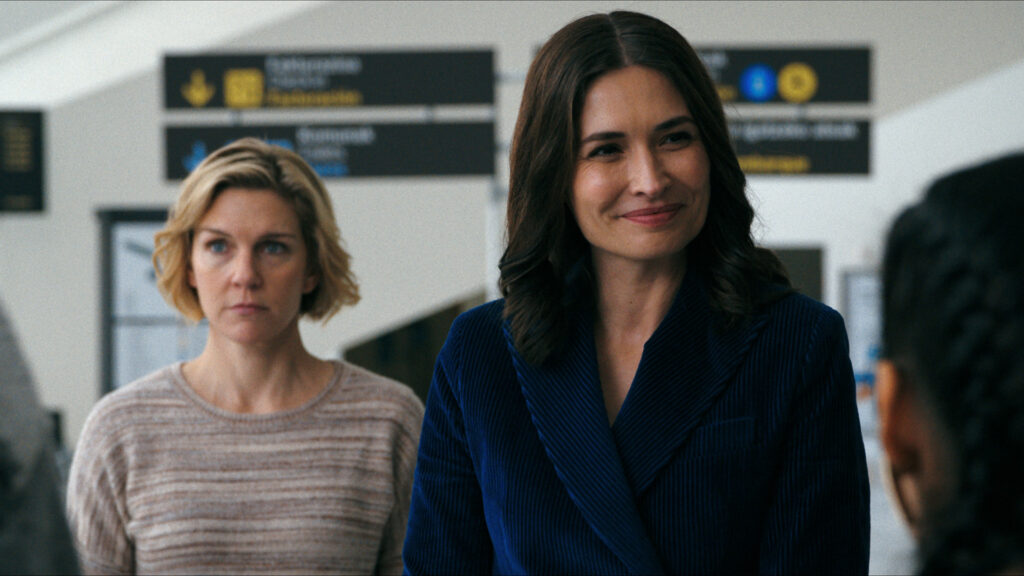
With the announcement that Pluribus season two is filming, I decided to re-watch the series with fresh eyes.
Pluribus is a weird show, okay? The sci fi premise (aliens) of a space virus, and the reality of a world where everyone except 13 people share a mind struck me as incredibly boring. There’s no need for phones or the internet. Want to know if there was a trans character on Baywatch? Someone knows, and now you know, and that’s that.
It is kind of sad, though, especially for those 13 people (well, 12 now) because if they have questions or want to research, they have to go to a library and hope it’s got the info.
It wasn’t until episode 9 that they finally showed us the biggest flaw in the hive mind, and I’m so happy they did.
Share Everything Or Not
There are a few downsides for the hive. Sharing everything means everyone can feel everything. Zosia said that she could feel herself being massaged, and massaging herself (though apparently drinking doesn’t work that way?). We’ve seen the flip side is also true. They can share pain.
Oddly when Carol shouted and they all shut down, it made sense. But later when she gave Zosia truth serum, the suffering of the cardiac arrest was isolated.
That was my solid hint that there was some individuality going on with the Others. I thought this was confirmed when Zosia was able to disconnect herself (somewhat) and spend a few days with Carol. After they had sex, and Zosia found out Carol had written a new story, Zosia was out of her mind delighted. Delight was something we hadn’t really seen with the Others. But the Others also rebuilt a shitty diner from memory, and flew a waitress back from Florida, just to help inspire Carol to have her write.
The Others Can’t Create …
The Others have no imagination. There will be no new tattoos, no new art, no new books. And since the Others know everything that everyone knows, the only way they could ever get any new media would be by someone like Carol.
Fundamentally, art happens because we can’t read each other’s minds. We cannot know how someone feels unless they tell us, and even then it’s subject to interpretations. This doesn’t happen for the hive. They go out of their way to make people happy (including themselves I’d imagine) because that’s the easiest way to be.
But you and I? We write, like this. We draw, we paint, we sing, and we share those things in the hopes that someone else out there gets it. That someone out there understands us, and feels what we feel. We like to share the human condition.
So why are they trying to bring her into their hive mind? If Carol is consumed, she will remove their only source of new happiness. Without her, and the rest of the immune, there’s nothing new out there. Sure they have all of Helen’s memories and, as such, they love Carol (see, that does work out). But … They can’t write her a new love letter, they can only make an echo of the past.
… Or Can They?
This isn’t entirely true though. Take the “virus” for example. The “virus” is an engineered biological RNA sequence decoded by astronomers from a four-tone extraterrestrial radio transmission originating hundreds of light-years away. At first we see it’s spread by bodily fluids (a bite, a kiss, etc), and later by aerosols. Like most things related to humanity, though some people have a natural immunity.
So how come, if they can’t create art, they can solve problems? Well, most of science and engineering solve defined problems with objective constraints. They can decode an alien transmission and refine dead humans into protein to survive, but those are all solving a clear problem. Art isn’t a problem to be solved. It’s a way to create.
Now I often argue that science requires imagination. Designing things in code, programming, is artistic in its own right. The Others can fix bugs, but they cannot create new software (for example) without that spark. They cannot ask the initial question of “Why does the apple fall from the tree but the moon doesn’t crash into the Earth?”
If the Others had showed up in the Stone Age, we’d still be there. And in fact, we’re headed there now!
Is Zosia Real?
This was a hard question to go over, and honestly I went back and forth a few times when we (finally) added her to the site. See, there’s no way for Zosia to ‘remove’ herself from the hive. Yes, we know there is a way, but that would fully reverse the effects. Zosia remains a walking Google-Bot.
Because the collective wants Carol to feel comfortable and safe enough to open up, to be able to create, the rest of the hive intentionally “steps back” in tone. When they do that, it allows Zosia’s physical individuality and Helen’s persona to dominate the foreground. But stepping back into the shadows is not the same as leaving the building.
After Carol spends the night with the Others, you can tell she’s trying like hell to ‘feel’ other people. The way Carol sobbed and hugged Zosia when the Others returned, that was her desperately seeing a connection. And she looks for that when she’s alone with Zosia. Carol wants that human spark, to find someone who will pick her over that collective.
For a second, they make us viewers think it’s happening. There’s chemistry, shared jokes, and that lingering physical closeness. And that intimacy is the ultimate queer baiting. It’s a trap to lure Carol in.
This Show Wouldn’t Work if Carol Was Straight
Here’s the rub. Without Carol being a lesbian, we’d be watching Invasion.
Pretty much every queer person I’ve ever known has struggled with their sexuality. Even those who are from the most kind, welcoming, accepting, loving family, has had that moment of “Why me? Why am I different?” Some of us are lucky that those moments are fleeting, but they remain familiar.
Straight romance (and representation) operates as ‘abundance.’ The world is built for them, the dating pool is limited by your culture, and seeing yourself on TV is expected. Queer romance has always existed under the auspice of scarcity. Even if you’ve never felt like an alien in your hometown, queers are all too familiar with the sensation. We joke about vibes and gaydar, but really we do spend time scanning a room and wondering who’s like us. That is, fundamentally, why LezWatch exists.
For Carol, a middle-aged lesbian whose partner died in a horrific manner, this is an existential story about queer isolation. She lost her person and now all but 11 other people are the same, and they seem to be weirdly okay with the new world order.
The Others are making an offer that, on face value, sounds amazing. Join us and you will never be alone again. Join us, and we will be you and love you. And that is the antithesis of our queer identities! We stand up and say “No, this is who I am, a lesbian, even if that makes me an outlier. I am different. I embrace my difference.”
By offering Carol the love from Helen, it can seem like the Others are acting out of care and mercy. But Carol knows that bitter truth so many queers have learned the hard way. Real love with another person needs for those people to be different. Love needs people to be stubborn idiots who chose each other. The Others want to ‘solve’ Carol’s grief by bringing her into the hive, where she will forever know Helen loved her.
And that’s the joke, isn’t it? Carol will know she was loved, and she’ll no longer care. In that hive, she won’t grieve and she won’t want. She will know but never feel.